
The Complete Career Change Program
All 9 guides in order, plus a 12-week plan that tells you what to do each week.
The video course has 11 modules and 22 narrated videos of about 8 minutes each, with the guide PDF inside every lesson. $29 a month, 14-day refund.
Get the programOnly need one thing? Buy a single guide.
Each guide is a PDF with worksheets you fill in. You pay once and download it straight away. Checkout is secure.
A free five-minute calculator that replaces “it’s too late” with three real numbers about the working years you have left.
See what is inside
Who it is for: Anyone in their 30s, 40s or 50s who keeps putting off a change because of their age.
- Count your working years to age 67
- Compare them with typical job tenure
- Name the real age obstacles, and answer them
What is inside
- The numbers. State pension ages and median job tenure, with a table by age
- Your calculator. An eight-line worksheet with a worked example
- The real obstacles. Money, retraining time, age bias, confidence, and how to respond to each
- Your next step. One small action and which guide to use next
You finish with:
- Your personal working-years number
- An honest list of obstacles with responses
- One next step for this week
A guided, six-stage process that takes you from vague restlessness to three tested directions and one confident next step, in about four weeks.
See what is inside
Who it is for: People who feel stuck in their current career and have no clear idea what else would suit them.
- Map your values, strengths and interests
- Generate and score real options
- Test your top three with small experiments
What is inside
- Take stock. Push and pull audit, energy log, keep/lose/gain
- Know your raw material. Values, transferable strengths, interests and non-negotiables
- Generate options. Five idea sources and three future sketches
- Filter. Fact sheets and a weighted scoring matrix
- Test. Career conversations and small experiments
- Decide and commit. A decision, a backup and a 30-day plan
You finish with:
- A one-page work profile
- Three directions scored against what matters to you
- Evidence from real conversations and experiments
- One chosen direction and a 30-day action plan
Four weeks of small, low-cost experiments that show you what a career is really like before you spend money on training.
See what is inside
Who it is for: Anyone with one or two possible directions who wants evidence before committing time and money.
- Write a hypothesis you can test
- Talk to, watch and work alongside the field
- Finish with a go, adjust or drop verdict
What is inside
- Week 1 · Hypothesis and conversations. Write your beliefs down, then talk to three practitioners
- Week 2 · See the work. Shadowing, virtual observation, events, volunteering
- Week 3 · Do a piece of the work. Design and finish a 6–10 hour mini-project
- Week 4 · Verdict. Hypothesis check and a 30-point fit scorecard
- Scripts. Introduction requests, cold messages and questions to ask
You finish with:
- Three to five conversations with people in the job
- At least one observation session
- A finished mini-project you can show
- An evidence-based go, adjust or drop decision
Find out whether you need to retrain at all, compare courses, degrees, bootcamps and apprenticeships on true cost and time, and choose one route with a budget.
See what is inside
Who it is for: Career changers with a target role who are facing course fees, funding forms and conflicting advice.
- The ten-advert test for what employers require
- Funding options by country
- True-cost and payback calculator
What is inside
- Do you need to retrain? Regulated vs unregulated roles and the ten-advert test
- Map your routes. Self-study to degree, compared on fit and time
- Find the funding. Schemes in England, the US, Canada, Australia, Ireland and New Zealand
- Vet the provider. Independent data sources, questions to ask, red flags
- True cost and the decision. Fees, lost income, payback months, and a scored comparison
You finish with:
- A clear verdict on whether a qualification is required
- Two or three routes with true cost and payback
- A list of funding to apply for
- One chosen route, budget and start date
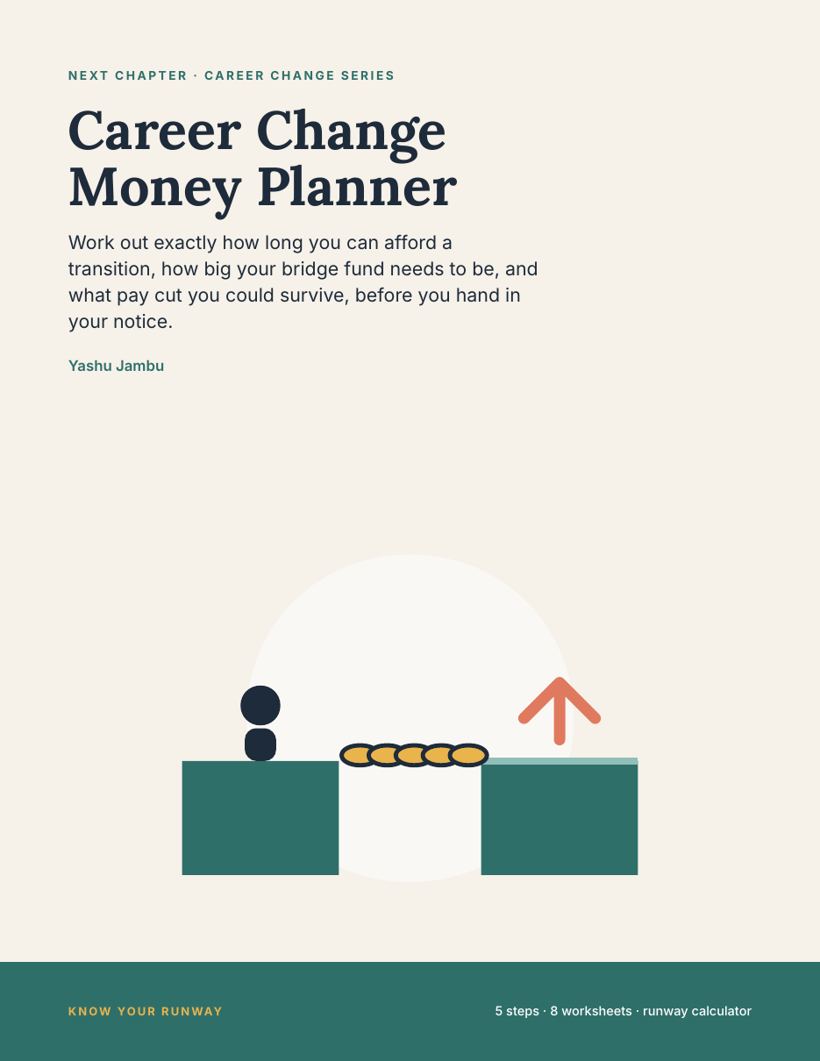
Work out how long you can afford a transition, how big your bridge fund needs to be, and what pay cut you could survive, before you hand in your notice.
See what is inside
Who it is for: Anyone whose change involves a pay cut, unpaid study, or a gap between jobs.
- Split essential and flexible spending
- Calculate your runway in months
- Find the lowest offer you can accept
What is inside
- Your real monthly number. Essential vs flexible spending from your statements
- Your runway. Savings ÷ monthly gap, with and without transition income
- The pay cut you can survive. Your take-home floor and maximum cut
- Build the bridge fund. Target, saving plan and 12-month tracker
- Your money-ready date. Transition models, stop signals and monthly check-in
You finish with:
- Your runway in months, best and worst case
- A bridge-fund target and date
- Your minimum acceptable salary
- Stop signals decided in advance
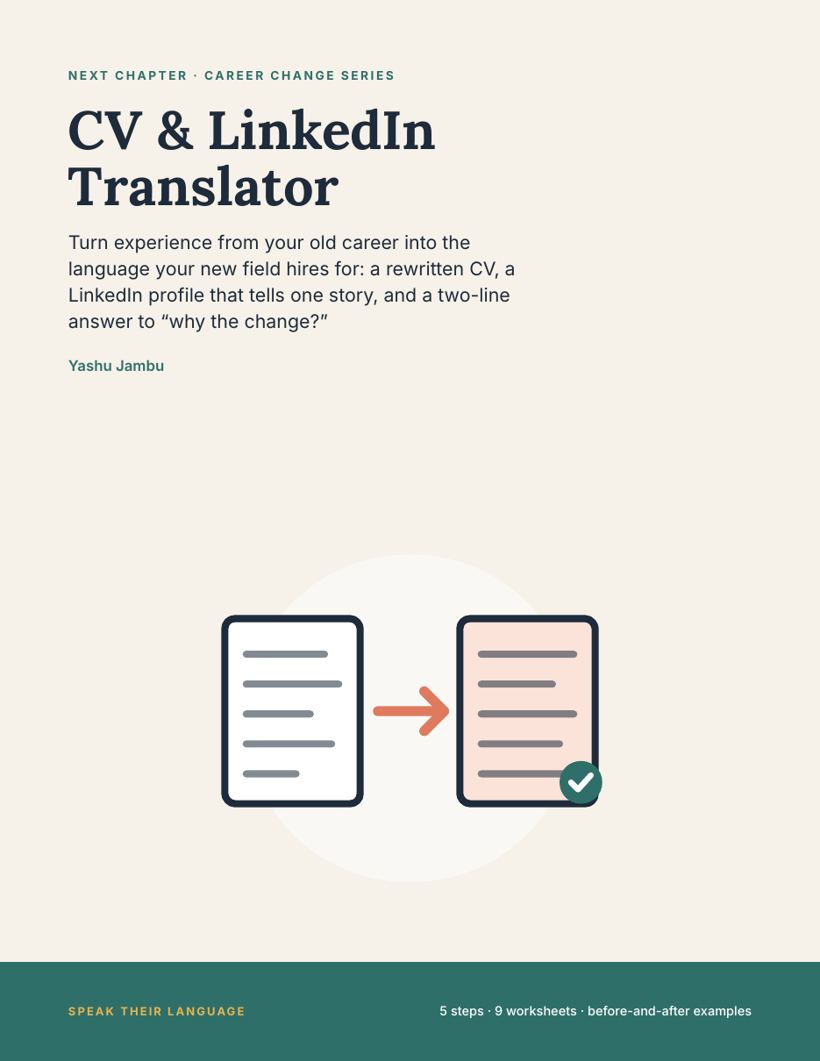
Turn experience from your old career into the language your new field hires for: a rewritten CV, a LinkedIn profile that tells one story, and a clear answer to “why the change?”
See what is inside
Who it is for: Career changers sending applications and hearing nothing back.
- Build a keyword bank from real adverts
- Rewrite duties as results
- Align CV, LinkedIn and your story
What is inside
- Learn the target language. Keyword bank and jargon swap list
- Mine your experience. The evidence formula and before-and-after bullets
- Rewrite the CV. Career-change layout, profile formula, cover note
- Rebuild LinkedIn. Headline, About, skills and visibility settings
- Tell the story. The bridge story and a consistency check
You finish with:
- A keyword bank built from real adverts
- Twelve or more translated achievement bullets
- A career-change CV and cover note template
- A two-line answer to “Why are you changing careers?”
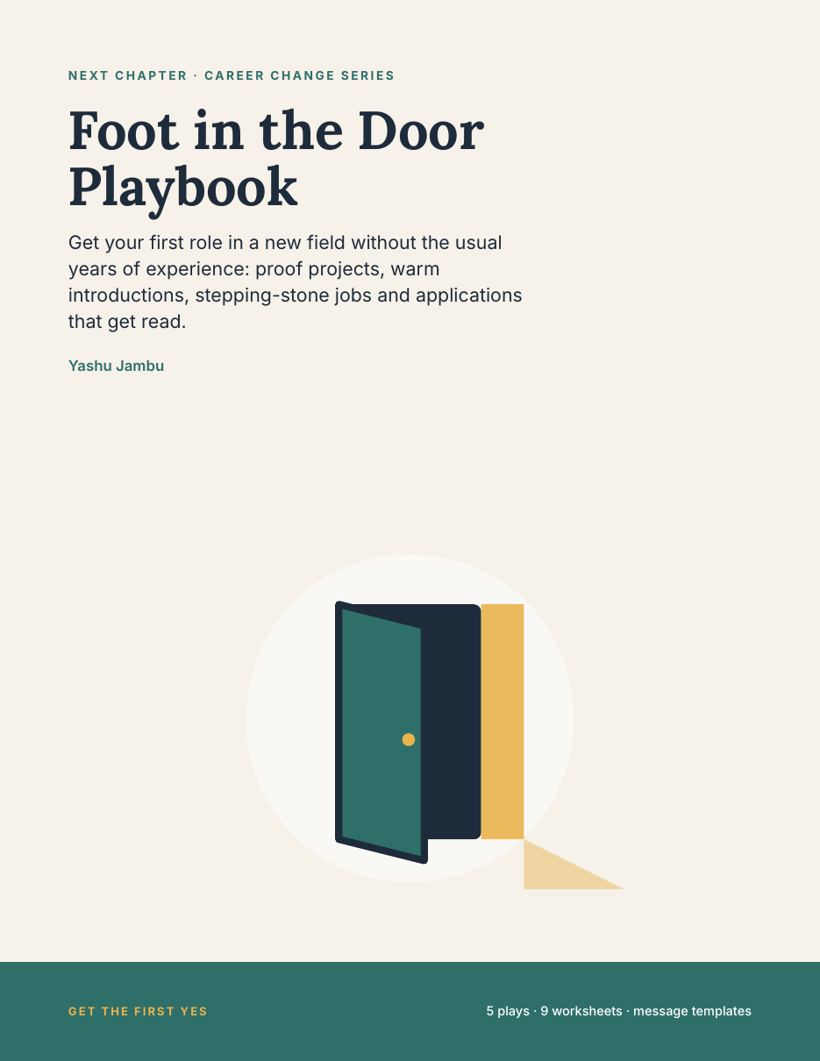
Five plays career changers use to get a first role in a new field: proof projects, warm introductions, stepping-stone roles, inside moves and targeted applications.
See what is inside
Who it is for: People who have the skills or training but keep hitting the “no experience” wall.
- Create proof with a small real project
- Get introductions instead of cold applying
- Find stepping-stone roles that hire now
What is inside
- Proof project. Plan it, finish it and write a one-page case study
- Warm introductions. Contact map and message templates
- Stepping-stone roles. Bridge jobs by target field, including adult apprenticeships
- Inside moves. Use your current employer’s trust
- Targeted applications. Where changers have an edge, plus a weekly scoreboard
You finish with:
- A finished proof project and case study
- Five conversations started through people you know
- Three stepping-stone job titles to search
- A weekly routine you can keep up
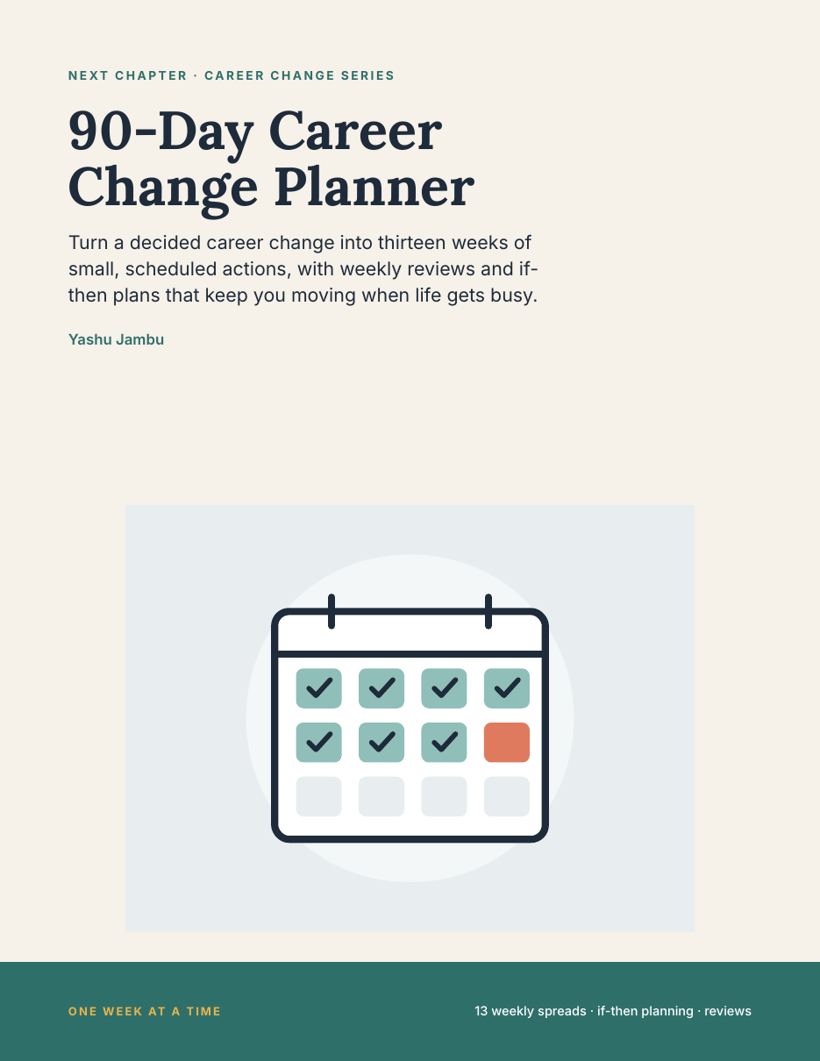
Thirteen weeks of three small, scheduled actions, with weekly reviews and if-then plans that keep you moving when life gets busy.
See what is inside
Who it is for: Anyone with a chosen direction who needs structure to make steady progress alongside a job.
- Thirteen weekly plan and review spreads
- If-then plans for your likely obstacles
- Monthly reviews to adjust course
What is inside
- Set up your 90 days. Goal, three milestones and your weekly rhythm
- Weeks 1–4 · Foundation. Research, conversations and set-up
- Weeks 5–9 · Build. Skills, proof work and profile
- Weeks 10–13 · Launch. Applications and follow-up
- 90-day review. What worked and your next 90 days
You finish with:
- A 90-day goal within your control
- About 39 small actions planned and tracked
- Weekly and monthly reviews
- A plan for the next 90 days
For teachers ready to leave the classroom: map where teaching skills transfer, translate them for employers, and plan an exit that fits the school year.
See what is inside
Who it is for: Classroom teachers thinking about leaving, especially in the UK where resignation dates follow the school year.
- Leave, adjust or stay: find out which
- Three rings of roles that use teaching skills
- Exit timeline that fits resignation dates
What is inside
- Leave, adjust or stay? Keep/lose sort and what to consider first
- Map where teachers go. Close to school, education-adjacent and further afield
- Translate your skills. School language to employer language
- Test and apply. Holiday-sized proof pieces by role
- Time your exit. Common resignation dates, the notice gap, leaving well
You finish with:
- A clear reason and must-haves for your next role
- A shortlist of two or three roles
- Teaching experience in employer language
- A dated exit timeline
For nurses thinking of leaving bedside care: explore non-clinical and adjacent roles, decide what to do about your registration, and reframe clinical experience for new employers.
See what is inside
Who it is for: Registered nurses who want to stay useful to healthcare, or move beyond it, without the ward.
- Four zones of roles, from clinic to corporate
- Keep or lapse your registration: the trade-offs
- Ward language translated for employers
What is inside
- What are you leaving? Keep/leave list and non-negotiables
- Explore the four zones. Roles, and whether registration is needed
- Your registration decision. Revalidation, costs and returning later
- Translate clinical experience. Translation table and your leaving story
- Plan the move. Transition routes, dated plan, first three actions
You finish with:
- Your non-negotiables written down
- A shortlist across four zones
- A registration decision you understand
- A transition plan with dates
Prices are in US dollars. See our privacy policy, terms and refund policy.